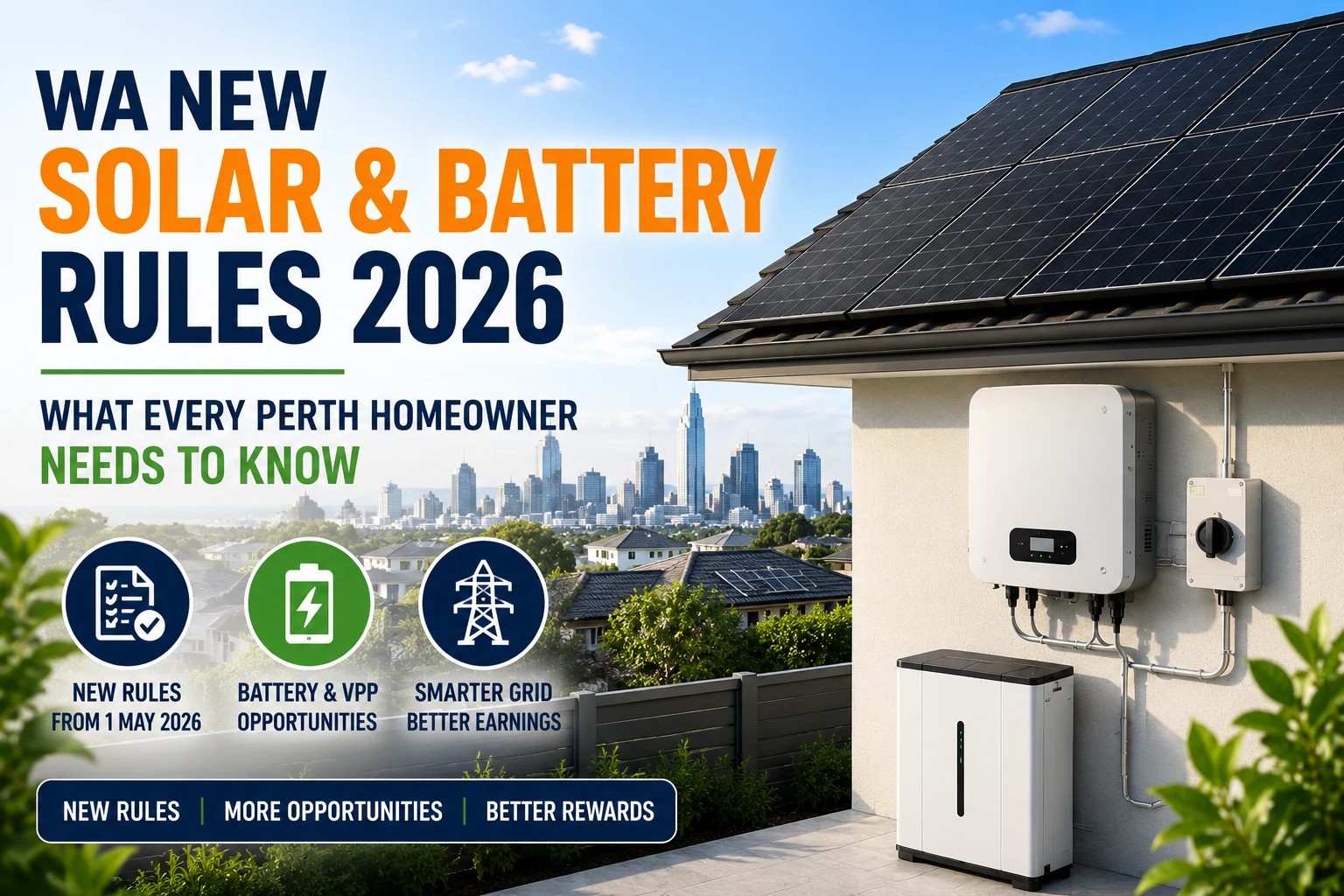
If you are a Perth homeowner with solar panels - or you are thinking about going solar - there are major changes happening right now that could affect your system, your installer, and your future energy earnings. From 1 May 2026, the Western Australian Government has rolled out new technical requirements for small-scale solar and battery systems across the South West Interconnected System (SWIS). Here is everything you need to know, explained in plain English.
New WA rules from 1 May 2026 increase the maximum solar inverter size for single-phase homes, require remote disconnection capability on all new systems, and open the door to virtual power plants and new energy earnings for Perth homeowners. All new installations must comply with updated Australian standards.
Why Is the WA Government Making These Changes?
Western Australia has one of the highest rooftop solar penetration rates in the world. On sunny afternoons, Perth households are generating so much solar energy that the electricity grid can struggle to absorb it all. The new requirements are designed to solve this problem - while creating genuine new opportunities for homeowners to earn more from their solar systems.
The changes are part of a broader shift towards a more flexible, intelligent electricity network where homes with solar and battery storage can participate actively in grid management. Think of it as transforming your rooftop from a passive power generator into an asset that helps stabilise the grid and earns you money for doing so.
According to Energy Policy WA, these changes "will support the continued uptake of renewable technologies, while establishing a foundation for customers with larger systems to participate in new products."
What Exactly Changed from 1 May 2026?
There are three core changes every WA homeowner and solar installer needs to understand:
| Rule | Before May 2026 | From 1 May 2026 |
|---|---|---|
| Single-phase inverter limit | 5 kW maximum | Up to 15 kW (or 30 kVA aggregate) |
| Remote management / export control | Optional — DEBS participants only | Mandatory on all new & upgraded systems |
| Australian Standard for inverters | Earlier versions accepted | AS/NZS 4777.2:2020 + "Australia Region B" grid code |
| Virtual Power Plant eligibility | Limited / not available | Available to all compliant new systems |
1. Higher Inverter Capacity Limits for Single-Phase Homes
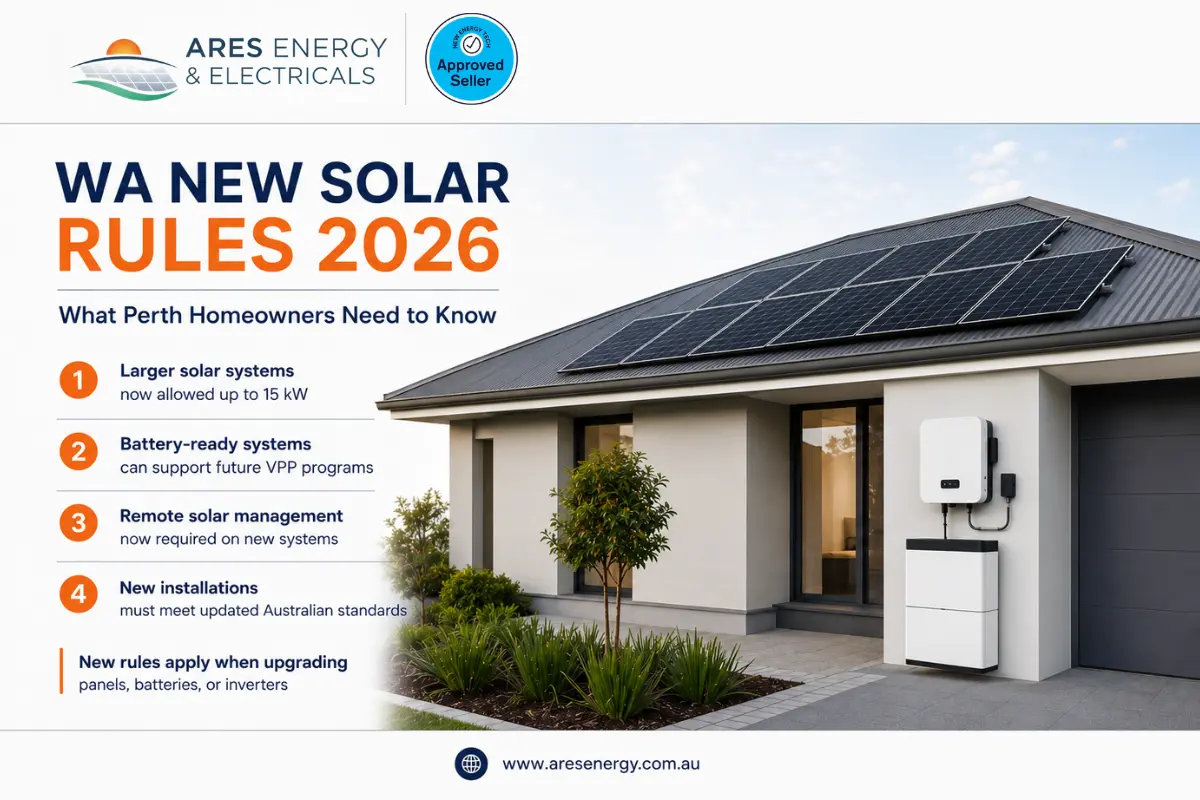
This is the change that affects the most homeowners. Previously, single-phase households were limited to a maximum installed inverter capacity of 5 kW. Under the new rules, single-phase homes can now install inverters up to 15 kW (or an aggregate of 30 kVA for sites with multiple inverters, including batteries).
For families who have been told their home cannot handle a bigger system because of old single-phase limits, this is excellent news. If you have an EV to charge, a pool, ducted air conditioning, or simply a large household, you can now install a system that genuinely matches your energy consumption rather than being artificially capped at a modest size.
Our team can design and install solar systems that take full advantage of the new capacity limits - including larger panel arrays paired with battery storage for maximum self-consumption and grid independence.
2. Remote Disconnection / Reconnection Capability (Emergency Solar Management)
This is the most technically significant change. From 1 May 2026, all new or upgraded solar and battery systems must either:
- Be capable of remote disconnection and reconnection by your electricity retailer (Synergy for most Perth residential customers), OR
- Be export limited to just 1.5 kW - meaning you can only feed a maximum of 1.5 kW back into the grid at any time.
The remote management option is far preferable for most homeowners. Being export limited to 1.5 kW severely reduces your ability to earn from feed-in tariffs and DEBS payments. Most modern inverters already support remote management functionality - but it must be configured at the point of installation by your installer.
This capability is commonly called "emergency solar management" and has actually been standard for most homes on the Distributed Energy Buyback Scheme (DEBS) for some time. The new rules simply make it mandatory across all new installations.
What does this mean in practice? Synergy can remotely reduce your solar export during periods of grid oversupply (typically sunny Sunday afternoons when demand is low). In exchange, you become eligible for new products - like virtual power plants - that can pay you significantly more than the standard feed-in tariff rate.
Remote disconnection capability must be configured at the time of installation - it cannot be added later as a software patch. If you are booking a solar installation or upgrade, confirm that your installer will commission remote management capability as part of the job. Every Ares Energy installation is fully compliant with the 2026 requirements.
3. Updated Australian Standards: AS/NZS 4777.2:2020
All new and upgraded inverters must comply with AS/NZS 4777.2:2020, including having the grid code set to "Australia Region B". This standard governs how grid-connected inverter energy systems must behave when connected to the Australian grid - covering everything from voltage and frequency response to anti-islanding protection.
Most inverters manufactured and sold in Australia from 2020 onwards already meet this standard. If you have a pre-2020 inverter, it may need to be assessed for compliance if you are planning any system changes. Our team can handle inverter assessment and replacement as part of any upgrade project.
What Do These Changes Mean for Perth Homeowners?
In a word: opportunity. The 2026 changes unlock several possibilities that simply were not available to most households under the old rules.
Virtual Power Plants - Earn More from Your Solar
With remote management capability, your home's solar and battery system can join a Virtual Power Plant (VPP) - a network of homes that collectively acts like a large power station. When the grid needs extra power during peak demand, the network dispatches stored energy and earns payments that flow back to participating households.
To participate meaningfully in VPPs, you will want a quality home battery storage system alongside your solar panels. The battery stores excess solar generation during the day, ready to be deployed and earn money during the evening demand peak.
Flexible Export Products
Synergy and other retailers are developing new tariff products that reward flexible export - allowing your retailer to optimise when and how much power you export, in exchange for higher payments during peak demand periods. These products are expected to deliver materially better returns than the standard DEBS rate for homeowners who participate.
Larger, More Capable Solar Systems
The capacity increase for single-phase homes is transformative. Families with high energy usage, electric vehicles, or plans to add battery storage can now install a system sized appropriately for their actual needs. There is no longer a reason to accept an undersized system "for now" and revisit the problem in five years.
Greater Energy Independence
With larger solar systems, better battery compatibility, and smarter grid interaction, Perth homeowners in 2026 have more tools than ever to reduce their reliance on grid power. Paired with a modern home battery system, a compliant solar installation can cover the vast majority of your household's energy needs year-round.
Does Your Existing System Need to Change?
Here is the reassuring news: the new rules apply to new and upgraded systems only. If you have an existing solar installation that you are not modifying, you are not required to retrofit remote management capability or replace your inverter to meet the new standard.
However, if you are planning to:
- Add more solar panels to your existing array
- Add a battery to an existing solar installation
- Replace a faulty or underperforming inverter
- Upgrade your system capacity in any meaningful way
...then the new requirements will apply to your upgraded installation. This is an important planning consideration. Our team can advise you on whether your intended changes trigger the new requirements and help you design a compliant, future-ready system from the outset.
Even if you are not required to upgrade, having your existing system professionally serviced and assessed is sound practice. Older systems can have degraded panels, worn DC isolators, or ageing inverters that benefit from attention - both for safety and for maximising the return on your original solar investment.
Planning a New Solar Installation? Here Is What to Ask Your Installer
If you are going solar in 2026, the opportunity has never been better - but getting the installation right matters more than ever. Here are the key questions to ask any installer before you sign:
- Does the inverter comply with AS/NZS 4777.2:2020? It must, and the grid code must be configured to "Australia Region B."
- Will you commission remote management capability at installation? This must be set up on the day - not retrofitted later.
- Are you familiar with Synergy's DER Functionality Requirements? Your installer needs to know how to register and configure your system with Synergy's remote management platform.
- What system size do you recommend given the new 15 kW single-phase limit? A good installer will design for your current and foreseeable future energy needs, not just the minimum viable system.
- Should I include battery storage from day one? Given the new VPP opportunities, pairing solar with battery storage from the outset is increasingly worth considering for the right households.
At Ares Energy, we have been across the 2026 requirement changes ahead of the deadline. Our solar installation service includes full compliance as standard - and we will explain exactly what it means for your home in clear, jargon-free terms during your consultation.
Ready to Go Solar the Right Way in 2026?
We will design a fully compliant 2026-ready system optimised for your household's energy goals. SAA accredited, NETCC approved. No obligation, no jargon.
Is Now a Good Time to Add Battery Storage?
Yes - and the new rules make the case even stronger. The 2026 framework is designed specifically to unlock battery storage as a grid asset, not just a backup power supply. If you already have solar and you have been on the fence about adding a battery, 2026 is the year to act.
Here is the case in brief:
- New VPP products will pay battery owners for stored energy during peak demand periods
- Export limiting (the less desirable alternative to remote management) caps your feed-in earnings - a battery helps you self-consume rather than export
- Battery prices have continued to fall while grid electricity prices have risen
- A battery installed under the 2026 framework is ready for next-generation grid service products
Our battery installation team works with all major battery brands and configurations, from compact residential units to whole-home storage systems. We will ensure your installation meets all battery safety requirements under the current framework - and positions you to benefit from every new product that comes to market.
What If Your Inverter Is Old or Non-Compliant?
Many inverters installed before 2020 may not fully comply with AS/NZS 4777.2:2020 or support the remote management protocols required by Synergy. If you are planning an upgrade, an inverter replacement may be necessary as part of the work.
The good news is that modern inverters from leading brands - Fronius, SolarEdge, SMA, Goodwe, Sungrow, Huawei - all support the new requirements and in most cases also deliver improved efficiency and monitoring capabilities compared to older units. Replacing an ageing inverter is often worthwhile on performance grounds alone, separate from the compliance question.
Unsure about your current inverter's compliance status? Reach out to us and we can assess your system and give you honest advice about whether an upgrade makes financial sense for you.
Do Not Overlook Your Switchboard
With larger solar systems now permitted, older homes may find their existing switchboard is not rated for the increased capacity. Before installing a 10-15 kW solar system in a home with an aged single-phase switchboard, an assessment is needed to determine whether a switchboard or meter upgrade is required.
This is standard practice for larger system installations, but it is worth budgeting for as part of your overall project. Our team includes licensed electricians who conduct a full electrical assessment as part of every installation quote, so there are no surprises on the day.
Quick Reference: What Changed and When
| Change | Effective Date | Who It Affects |
|---|---|---|
| Inverter limit raised to 15 kW (single-phase) / 30 kVA aggregate | 1 May 2026 | All new and upgraded installations |
| Remote disconnection required OR export limited to 1.5 kW | 1 May 2026 | All new and upgraded installations |
| AS/NZS 4777.2:2020 compliance + "Australia Region B" grid code | 1 May 2026 | All new and upgraded inverters |
The Bottom Line for Perth Solar Owners
The WA Government's 2026 solar and battery requirements represent the most significant change to residential solar installation rules in years. For Perth homeowners, the news is genuinely positive: larger systems are now permitted, smarter grid interaction unlocks new revenue streams, and a clear pathway exists to virtual power plants and flexible export earnings that simply were not available before.
The key is ensuring any new installation or upgrade is carried out correctly - right inverter, proper commissioning, and a system design that takes full advantage of the new limits and opportunities.
Whether you are installing solar for the first time, upgrading an existing system, or adding a battery to an existing solar setup, the Ares Energy team is ready to help. We cover Perth and surrounding areas, and every installation is backed by our quality workmanship guarantee.
Book Your Free Solar Consultation Today
Make sure your next system is built to thrive under the 2026 rules. Perth's most trusted solar and electrical team is ready to help you make the right decision.