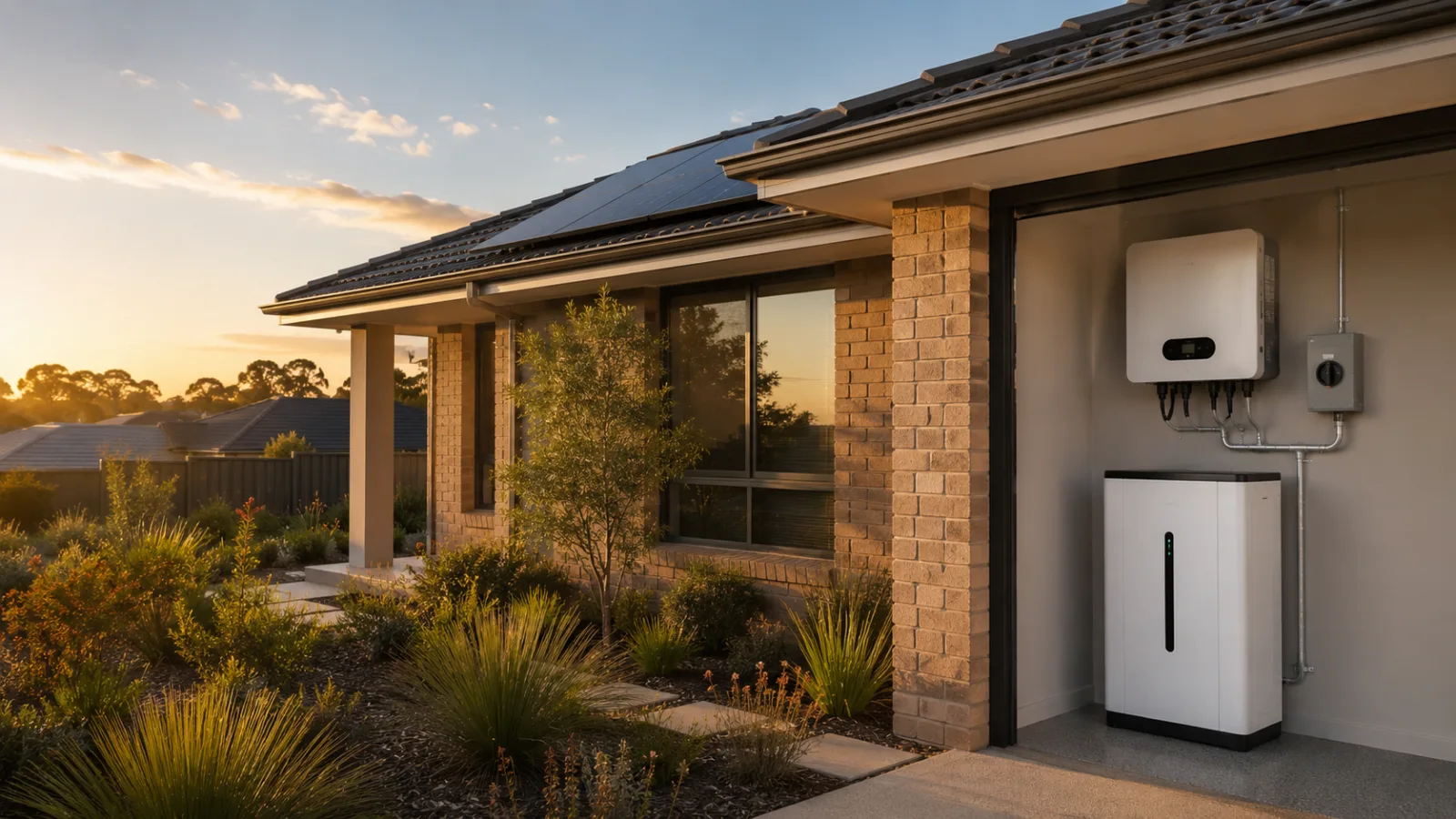
If you have solar in Perth, you have probably noticed your bill is not falling as fast as it used to. That is not your imagination, and it is the single biggest reason a home battery in Perth has gone from a luxury item to a genuinely sensible purchase in 2026. This guide covers what a battery actually costs, the two rebates you can claim, and roughly how long it takes to pay for itself.
 Tap to enlarge
Why Perth Homes Are Suddenly Interested in Batteries
Under Synergy's Distributed Energy Buyback Scheme (DEBS), what you get paid for exported solar depends on the time of day:
- 10c per kWh for power exported between 3pm and 9pm
- 2c per kWh for power exported at any other time
- Paid on the first 50 kWh you export each day
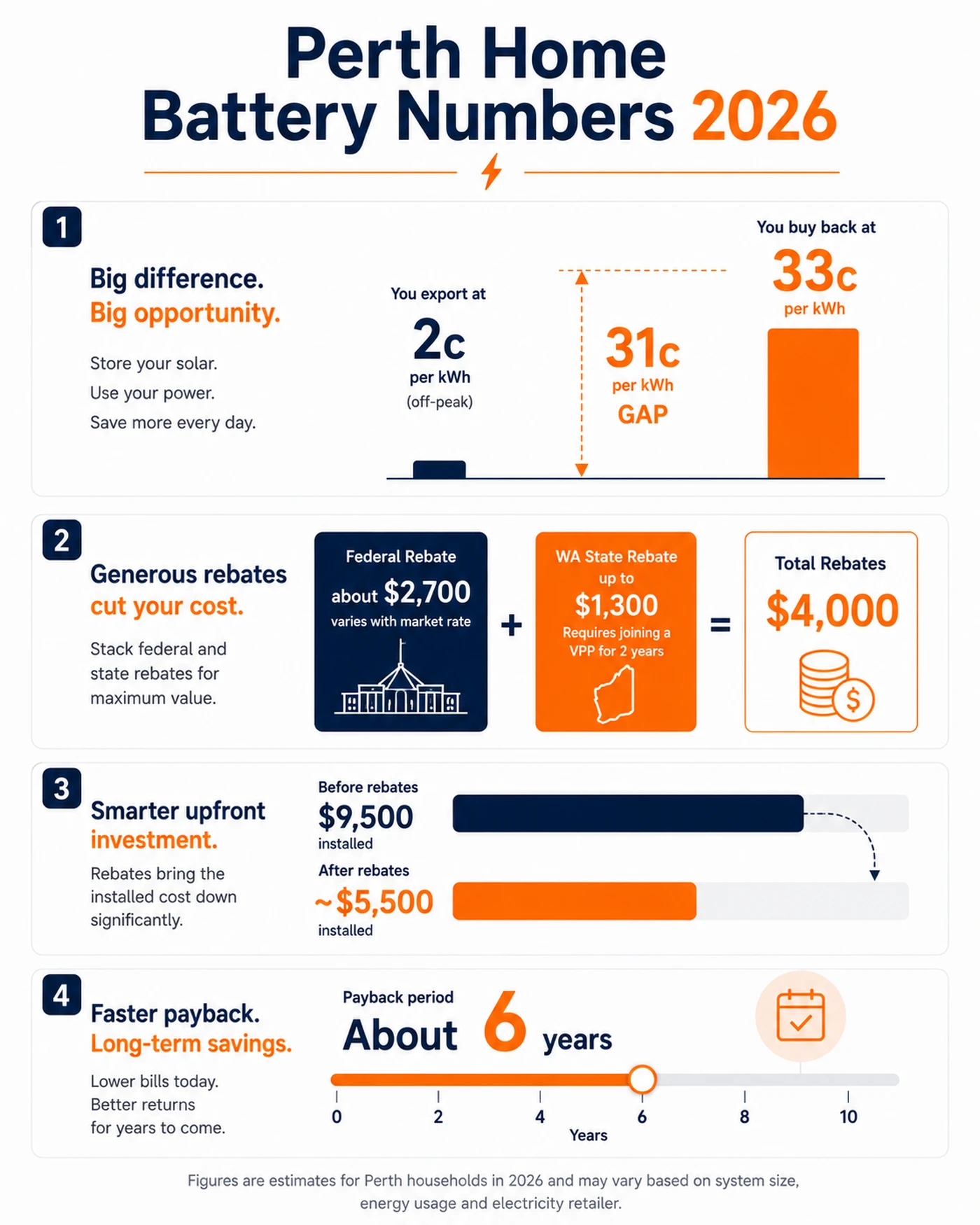
The problem is that most rooftop solar produces the bulk of its power before 3pm. So a typical Perth home exports its surplus at 2c, then buys electricity back in the evening at 33.26c on the Synergy Home Plan (A1) rate from 1 July 2026.
That is a gap of more than 31c on every unit. A battery is simply a way of keeping that power instead of giving it away.
Every kilowatt-hour you store and use yourself instead of exporting off-peak is worth about 31c to you. Store 8 kWh a day and that is roughly $900 a year.
What a Home Battery Costs in Perth in 2026
| Battery Size | Typical Installed Price | After Both Rebates |
|---|---|---|
| 10 kWh (battery only) | $8,000 to $9,500 | $4,000 to $5,500 |
| 10 kWh (with new hybrid inverter) | $10,000 to $12,000 | $6,000 to $8,000 |
| 13 to 16 kWh | $12,000 to $16,000 | $7,500 to $11,000 |
Prices vary with brand, whether your existing inverter can be reused, and how much electrical work your switchboard needs. Anyone quoting without inspecting your switchboard is guessing.
The Two Rebates You Can Claim
1. The Federal Cheaper Home Batteries Program
This is a national discount applied at the point of sale, so you do not claim it back yourself. Since 1 May 2026 it is calculated at 6.8 certificates per usable kWh, which works out to roughly $2,700 on a 10 kWh battery. The exact dollar figure moves with the certificate market, so ask your installer to show the amount on the quote.
Larger batteries still qualify, but capacity above 14 kWh is paid at a reduced rate.
2. The WA Residential Battery Scheme
This is the state rebate, on top of the federal one. Synergy customers in the Perth metro area receive $130 per usable kWh, capped at $1,300. Horizon Power customers in regional WA receive a higher amount.
To qualify, your battery must be installed on or after 1 July 2025, and you must join a Virtual Power Plant for at least two years.
The WA rebate requires a two year Virtual Power Plant commitment. That means your retailer can draw on a share of your stored power at peak times. Most households barely notice it, but you should understand it before signing, because pulling out early can mean repaying the rebate.
A Realistic Payback Example for a Perth Household
Take a family in a Perth suburb with a 6.6 kW solar system, exporting most of it before 3pm and using around 20 kWh a day.
- Power shifted from export to self use: about 8 kWh a day
- Value of each shifted unit: about 31c
- Annual saving: roughly $900
- Net cost after both rebates: around $5,500
That is a payback of about six years, and closer to nine years if your home needs a new inverter and switchboard work. Most quality batteries carry a ten year warranty, so a well sized system should pay for itself inside its warranty period.
What Size Battery Suits a Perth Home?
The most common mistake is buying too big. A battery only earns money when it fills up and empties again, so there is no value in capacity your solar cannot refill.
- 5 to 6.6 kW solar: a 10 kWh battery is usually the sweet spot
- 10 kW or larger solar: 13 to 16 kWh can be justified
- Small solar or high daytime use: consider adding panels first
If your roof still has space, adding panels is often the cheaper first move.
Three Things That Add Cost to a Battery Quote
Your Switchboard
Older Perth homes frequently need a switchboard upgrade before a battery can be safely connected, particularly if the board still has ceramic fuses or no RCD protection.
Your Inverter
If your existing solar inverter is not battery ready, you either add a separate battery inverter or replace it with a hybrid unit. This is the single biggest swing in a quote.
Compliance with the 1 May 2026 Standards
Any new battery in the SWIS must meet the technical standards introduced on 1 May 2026, including remote management capability.
Ask every installer three questions: can my current inverter be reused, does my switchboard need upgrading, and is the federal rebate already deducted from this price?
So, Is a Home Battery Worth It in Perth?
For most Perth homes with existing solar, decent daytime export and evening usage, yes. The combination of a 2c export rate, a 33c purchase rate and around $4,000 in rebates makes the numbers work in a way they simply did not three years ago.
Book a Free Battery Assessment in Perth
Ares Energy is an SAA accredited installer and NETCC approved electrical contractor, working across Perth since 2019. We will inspect your switchboard, check whether your inverter can be reused, and give you a fixed price with both rebates already applied.
Call 1300 717 583 or request a free consultation.